- Webinars
Using Information and Data to Make Aquifers Visible
Background
Transboundary aquifers connect countries through a resource that is largely invisible and, when data is limited, often difficult to fully understand. Building a shared understanding of these systems is therefore an important foundation for sound policies, governance and effective cooperation between countries.
Against this backdrop, IWRA’s Latin America and Caribbean (LAC) Geographic Chapter launched Transboundary Aquifer Systems in Latin America, a five-part webinar series running from August to October 2026 examining the various challenges and opportunities relating to groundwater management across the region.
The series started with Part 1: International Cooperation in the Guaraní Aquifer: Lessons Learned and Future Challenges.
The second session is taking place Tuesday 8 September at 13:00 ART/ 18:00 CEST and, like all the sessions in the series, it will be held in Spanish, with simultaneous English translation via subtitles.
Part 2: Using Information and Data to Make Aquifers Visible
Through a variety of case studies, our expert panel will assess how groundwater data can be effectively generated, updated, and shared between countries. The discussion will also consider the need for common criteria when building shared databases, so that a more complete understanding of aquifer systems can be attained.
In doing so, the webinar will provide insights into how effective information management can help reduce uncertainty, strengthen institutions and better inform policies and governance for transboundary aquifer management.
Panel
Host
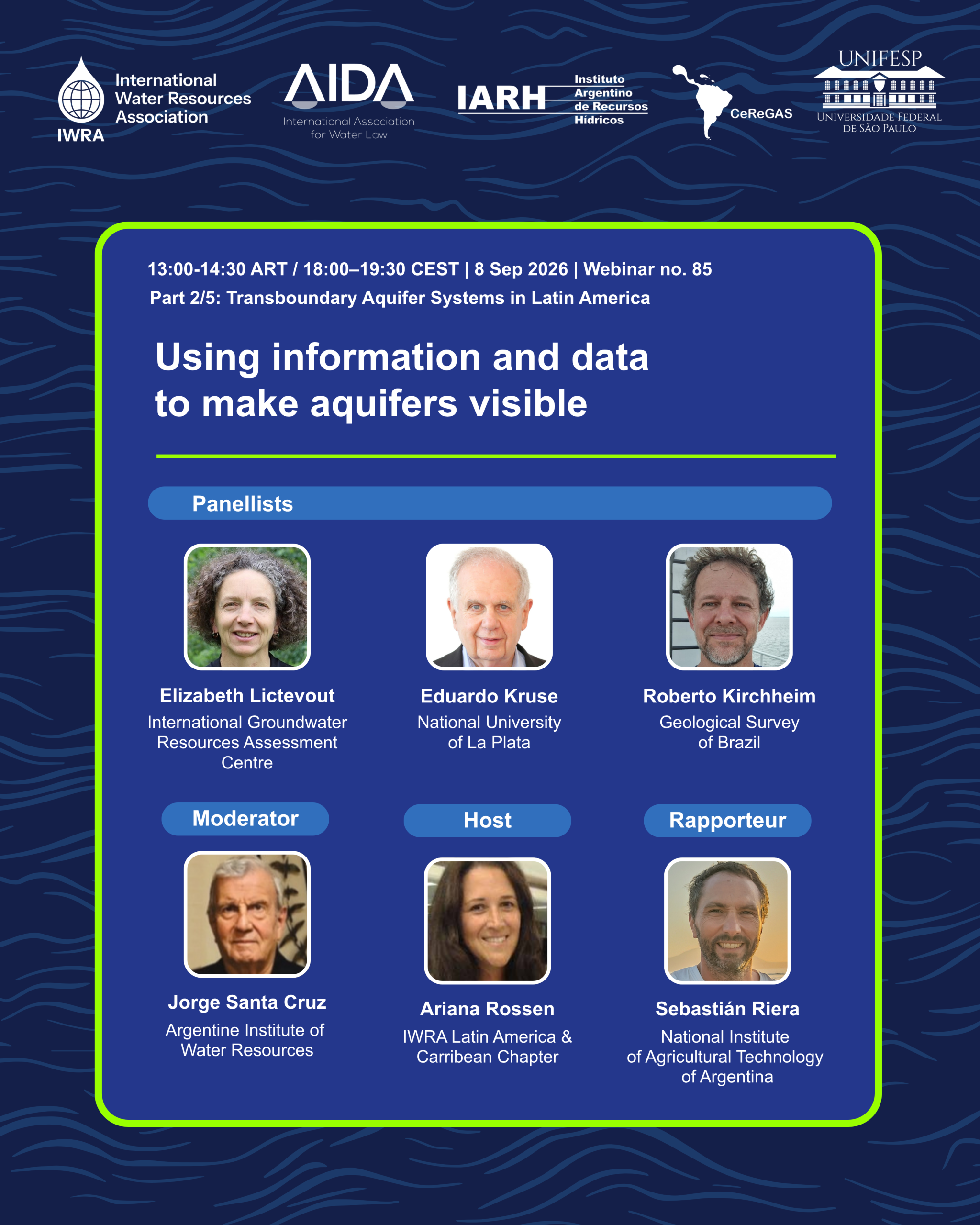
- Ariana Rossen, IWRA Latin America & Chapter
Speakers
- Elizabeth Lictevout, International Groundwater Resources Assessment Center
- Eduardo Kruse, La Plata National University
- Roberto Kirchheim, Geological Survey of Brazil
Moderator
- Jorge Santa Cruz, Argentine Institute of Water Resources
Rapporteur
- Sebastián Riera, National Institute of Agricultural Technology of Argentina
About the webinar series
Drawing on more than two decades of experience with the Guaraní Aquifer and other transboundary systems in the region, leading experts will share their findings and discuss with the audience practical approaches to foster knowledge exchange and strengthen groundwater governance in Latin America and beyond.
Along its five sessions, the webinar series Transboundary Aquifer Systems in Latin America aims to examine the various scientific, climatic, governance, and policy dimensions of transboundary systems in the region, through a combination of expert presentations, panel dialogues, and audience participation.
The webinar series is designed to follow a logical progression, with each session exploring a different aspect of transboundary aquifer systems while contributing to a broader understanding of their governance and management in Latin America.
All sessions start with presentations, followed by a structured panel discussion, a roundtable Q&A, and conclusions provided by the moderator.
The five sessions will be held in Spanish, with simultaneous English interpretation available in subtitles.
Programme
*All sessions take place 13:00-14:30 ART (Argentina time) / 18:00-19:30 CEST
- 25 August: “International Cooperation in the Guaraní Aquifer: Lessons Learned and Future Challenges” (Watch the recordings)
- 8 September: “Using Information and Data to Make Aquifers Visible” (Watch the recordings)
- 22 September: “Overcoming Structural Challenges in Groundwater Governance” (Watch the recordings)
- 6 October: “The Role and Potential of Groundwater Organisations in Latin America” (register here)
- 20 October: “Aquifers, Strategic Uses, and Conflicts in the Context of Climate Change” (register here)
Join us and be part of this important conversation!