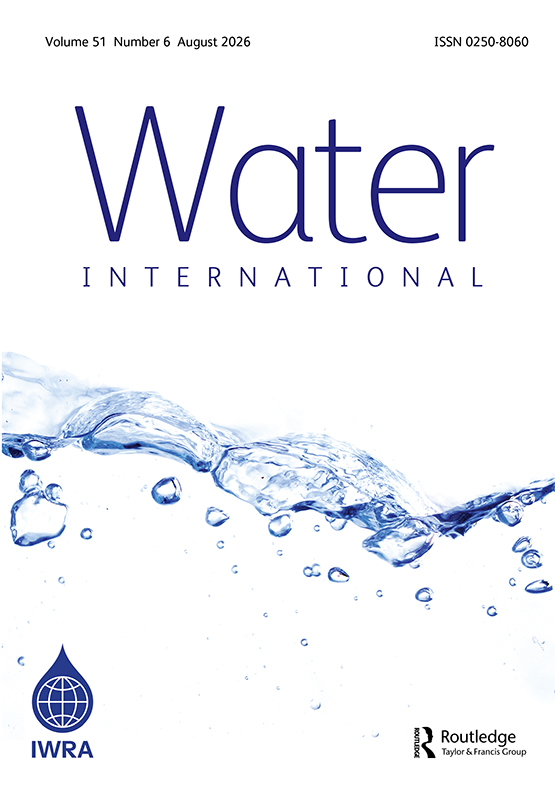
Latest edition of Water International is out now!
This regular submissions issue has a strong focus on transboundary waters, reflecting the central role of shared rivers and aquifers in today’s water governance challenges. It also includes contributions on water security and water governance, and closes with a book review.
Transboundary governance
The issue opens with a set of three articles exploring different aspects of transboundary management:
- One article examines Afghanistan’s Qosh Tepa Canal and its potential implications for the Amu Darya River, which flows through several Central Asian countries. It considers how this major unilateral project intersects with Afghanistan’s domestic state-building and wider transboundary relations in the region.
- The Euphrates–Tigris Basin, shared by Turkey, Syria, and Iraq, is explored in another article through the concept of “conflictual cooperation”. Here, it is highlighted how technical collaboration, diplomatic dialogue, and unilateral action can coexist within the same basin.
- The Sava River Basin in the Western Balkans and the Syrdarya River Basin in Central Asia are the basis for a comparative analysis of trust and data sharing in transboundary waters. The article argues that while trust is essential, it must be embedded in institutions in order to effectively support international cooperation.
Water security
How does water insecurity influence households’ abilities to relocate? The wider impacts of water stress on mobility are addressed in an article through the relationship between water worry, hygiene, and interpersonal conflict.
Drawing on data from 22 sites in 19 low-and middle-income countries across Latin America, sub-Saharan Africa, and Asia, the article points to the role that water (in)security can play in decisions regarding household relocation.
Water governance
In China, virtual water trade provides insight into how economic structures, trade patterns, and regional inequalities contribute to uneven water distribution. The article considers how water-intensive production in water-scarce regions can deepen local shortages, raising important questions of resource justice and interregional coordination.
Note: This is our Editor’s Choice for this issue of Water International! Our publisher Taylor & Francis makes it free access for a limited period.
Don’t miss the opportunity to read it!
Book review
The issue closes with a review of Emerging Pollutants – Protecting Water Quality for the Health of People and the Environment (Zandaryaa et al., 2025).
The review analyses the book’s comprehensive synthesis of the current knowledge on emerging pollutants. It also draws attention to important data gaps and on-going challenges, especially around the growing evidence base on endocrine disruptors and per- and polyfluoroalkyl substances (PFAS, also known as ‘forever chemicals’).