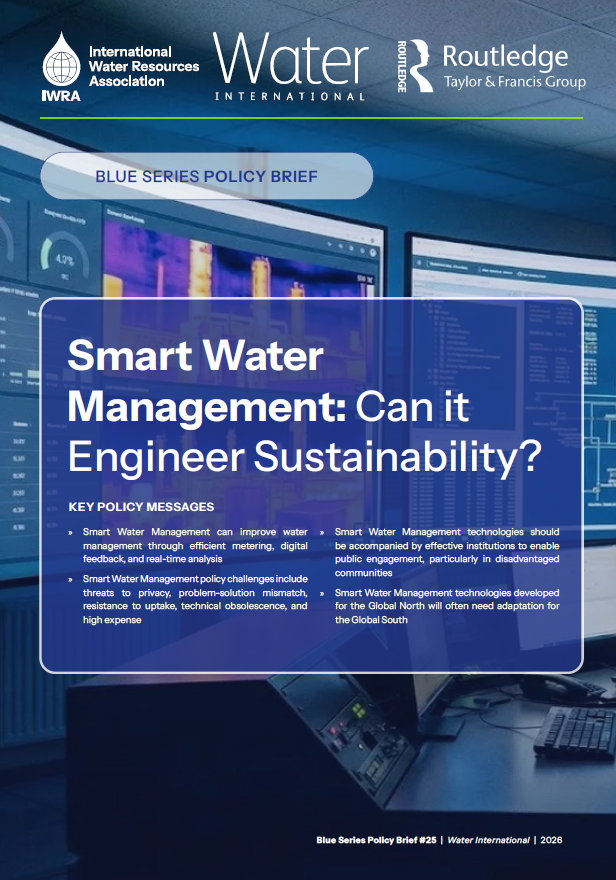
Water International Policy brief - Smart Water Management: Can it Engineer Sustainability?
Stronger governance is needed to avoid over-reliance on technology
Access the Policy Brief
–
The latest Blue Series Policy Brief by IWRA draws on research from the Water International Special Issue “Smart Water Management: Truly intelligent or just another pretty name?”, to make recommendations for an efficient and effective use of Smart Water Management (SWM) technologies.
Opportunities and challenges
Smart Water Management is broadly defined as the application of Information and Communications Technology to water management. With increasing water stress and political mandates to support environmental sustainability, it has become an appealing policy tool for progress on humanitarian and developmental policy goals, including SDG 6.
Smart Water Management represents a pathway to provide fair and equal access to water while improving its quality and operational efficiencies. While it does provide measurable improvements, it also has broader impacts and creates policy challenges, including threats to privacy, technical obsolescence, job losses, higher costs, and regional differences.
Different experiences, a variety of purposes
The Policy Brief draws on Smart Water Management cases from around the world, applied for different purposes, such as:
- Real-time monitoring of water quality and quantity in Mexico
- Integrated water management, to both minimise flood damage and ensure water supply in South Korea
- Integrated governance of institutionally fragmented sanitation systems in Greater Paris, France
- Monitoring tools to improve irrigation decision-making and reduce water use in Southern Africa
- Improvement in availability and quality of water data in the Canary Islands, Spain
The collection of experiences shows that ‘smart’ is not only a technological attribute, but also as a way of thinking about water management that accounts for risks, contingencies, and connections with other policy domains.
Smart Water Management technologies should be accompanied by effective institutions and strong regulatory capacities, taking into account local needs, and enabling public engagement, particularly in disadvantaged communities.
Since substantial investment is often needed for enabling technologies, decisions should be judicious and realistic., Technologies developed for the Global North will often need adaptation for the Global South.
Looking forward: making it really ‘smart’
Overall, Smart Water Management is just one among many complementary solutions to make existing systems more efficient and effective.
If coupled with broader efforts to ensure environmental awareness and participatory policymaking, Smart Water Management can be a great tool to foster a new generation of water management – one that is sustainable and ‘smart’ in all senses of the word.
IWRA’s Policy Briefs
IWRA publishes two series of Policy Briefs: Blue and Green. Both series aim to provide high quality analysis and practical recommendations for policy makers on important development issues.
Water International Blue Policy Briefs are based on thematic special issues of IWRA’s journal and published with the support of Routledge Press.
Access the latest Policy Brief | Explore all our Policy Briefs