Mongolia Chapter
Background
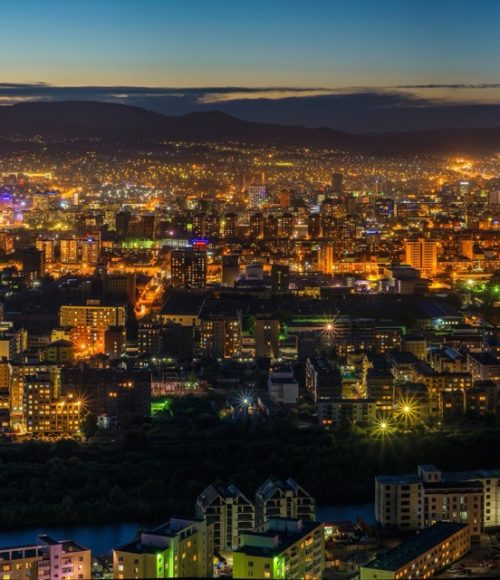
The term “Water Security” has been identified as an area of focus for water research and management during the eight-year period (2014-2021) by the United Nations Educational, Scientific and Cultural Organization (UNESCO) International Hydrological Program. For this the urban water security is considered to be the vital point for the successful implementation of the program. According to the United Nations it is projected that by 2050, 68% of the world population will be living in the cities. Compounded by climate change driven natural disasters and rapidly growing population concentration, urban water security is the emerging issue globally and Ulaanbaatar, Mongolia is no exception.
Adopting sustainable water systems towards urban water security needs to be addressed through multiple disciplines far beyond water access and sanitation. Gaps in research activities have been persisting on a variety of topics regarding urban water security, specifically for the developing countries such as Mongolia. As such, there is an urgent need to galvanize the Mongolian water sector to better understand the value of the water, by conducting research on emerging and future urban water security issues in the context of the SDGs and to document these studies. For these reasons the IWRA Executive Office established the Mongolia Chapter on the theme of Urban Water Security.
Objectives
The Mongolia Chapter objectifies conveying knowledge about urban water security to water professionals and industry, young professionals, students and community representatives at all levels of government, including national and international agencies, in order to facilitate open dialogue on the operational conditions and management of urban water with the ultimate goal of disseminating knowledge of water security for all. The series of engagement activities raising civic participation on discussion about economic, political and social challenges seeks to promoting solutions and best practices for the water community. We hope to bring about holistic and sustainable impact on the urban communities.
Organisation
- Angela Million – Chairperson
- Nomundari Erdene– Chairperson
- Ariuntuya Tserendorj – Co-Chairperson
- Christian Fischer – Co-Chairperson
- Silvia Cardascia – Co-Chairperson
- Myadagbadam Dulamsurankhor – Communication and website officer
- Bolor Altansukh – Secretary and membership officer
Introduction: Efficient and equitable governance is a key for achievement water security. For this, IWRA Mongolia Chapter established Governance Working Group by which the topics related to the water governance will be discussed.
Chair: Nomundari Erdene
Mission: Facilitate open dialogue, conduct research work, promote water governance as a key for sustainable development.
Activities: Webinars and policy briefs.
Introduction: Key component for urban water management is natural disaster and its associated risks. For this, understanding the risks of natural disaster, its underlying hazards and vulnerability is essential.
Chair: Enerelbuyan Enkhbat
Mission: Conduct and present research works on natural disaster risk reduction.
Activities: Organise webinars and production of research work.
Introduction: Sustainability in environment and ecology provides the broader concept of human security. Urbanization and environment have always been a topic of debate in terms of compromise.
Mission: Conduct research work on the trade offs and complex relations of urbanization and environment.
Activities: Present the outputs of the research work, conduct and organize online events such as webinars.
Introduction: Urban water security is largely dependent on the infrastructure and service provision systems. Although Urban Water Security of Ulaanbaatar has been improved drastically in the last 2 decades, the sole problem that underlies is the inequality for water provision systems.
Chair: Myadagbadam Dulamsurankhor.
Mission: To convene study on the current and previous infrastructure development project and provide interpretation on the objective of the future projects.
Activities: Organise online events, and production of contents.
Introduction: It is highly experienced that the Mongolian water sector is lagging behind in capacity building. The practitioners and experts in the water sector are in low numbers compared to other sectors. For this reason, the community and youth engagement, especially students who are interested in the topic, are in need to be facilitated.
Chair: Ariuntuya Tserendorj
Mission: To bridge the gap between theoretical knowledge and practical experience. Knowledge and experience sharing with young professionals and practitioners.
Activities: Student and young professional engagement events, workshops and seminars.
Introduction: Variety of the platform for the outreach is definitely an advantage for every platform. The podcasts are well known in its convenience for information delivery via interviews and conversations.
Chair: Tuguldur Enkhtsetseg
Mission: To facilitate open dialogue within the Mongolian and international experts and practitioners operating in the water sector.
Activities
The series of engagement objectifies to expedite discourse on the goals and ways-forward to the sustainable water transitions and achieving urban water security:
- Definition of urban water security (what does it mean, how we can assess urban water security, what are key challenges and opportunities).
- Highlight good practices and existing challenges of achieving urban water security.
- Defining the priorities of urban water security at different scales.
Understanding:
- What are the many definitions of sustainable water systems and how it can be unified
- How sustainable water system differ between cities and economies? Where does Ulaanbaatar stand?
- What is the sustainable water governance, policy, development, and financing; what are the implications of these elements on adopting the sustainable water systems?
- How different cities adopting the new paradigm of sustainable water system towards water security? To what extent have urban areas adopted this and where does Ulaanbaatar stand? To what extent, or in what ways, have urban water systems incorporated or adopted processes and practices of sustainability
- What are dimensions of the urban water security? And what dimensions Ulaanbaatar needs to apply to improve the sustainable water systems?
Outputs
The Chapter will work on four main tracks of knowledge, policy, technology, and communication to have a holistic and sustainable impact.
The Chapter will undertake the following activities:
- Develop publication of articles, guides and manuals on related topics.
- Organize webinars, conferences, and
- Initiate research papers and
- Facilitate communication and interaction between other regional chapters and members of IWRA.
- Encourage the promotion of science, technology, and the best practices through IWRA communication
- Policy Dialogues – to be initiated with policy makers, scholars, and practitioners.
- Policy Briefs – based on the policy dialogues.
Recent Updates
The Mongolia Water Leadership Program has objectified conveying knowledge and facilitating dialogue around water security among the water practitioners operating in Mongolia. The program has provided excellent opportunities for the participants to delve into and exchange opinions with international experts and researchers. The 6-month program has boasted and galvanized youth engagement in the water sector in Mongolia.